
Wi4impact #3 – Who are we blogging and podcasting for?
Digital media create new ways for communication and interaction, enabling dialogical and interactive knowledge transfer. Academia has adopted these direct communication channels to engage with the public, addressing new responsibilities embedded in the ‘third mission’ of research and science. Over the past 15-20 years, blogs and podcasts have become established as knowledge transfer media. This blog post examines German academic blogs and podcasts, exploring their role as transfer media and investigating the conceptual goals, target audiences, and working conditions that shape their production. The Wi4impact online survey among producers revealed that the media studied primarily target the public—particularly citizens with a general interest in science and research—as well as students and actors within the scientific community, with the latter group making up a significantly larger proportion of the audience for science blogs.
Digitale Medien eröffnen neue Wege der Kommunikation und Interaktion und ermöglichen einen dialogischen und interaktiven Wissenstransfer. Auch die Wissenschaft nutzt diese direkten Kommunikationskanäle, um mit der Öffentlichkeit in Kontakt zu treten und so den neuen Verantwortlichkeiten der sogenannten ‘Third Mission’ von Forschung und Wissenschaft nachzukommen. In den letzten 15–20 Jahren haben sich Blogs und Podcasts als Medien des Wissenstransfers etabliert. Dieser Blogbeitrag gibt einen Überblick über Ergebnisse einer Befragung deutscher akademischer Wissenschaftsblogs und -podcasts. Die Befragung diente der Untersuchung konzeptioneller Ziele, Zielgruppen und Arbeitsbedingungen der Produktionen. Die Wi4impact-Online-Umfrage unter Produzierenden ergab, dass sich die untersuchten Medien vorrangig an die Öffentlichkeit, vor allem an Bürger:innen mit allgemeinem Interesse an Wissenschaft und Forschung, sowie an Studierende und an Akteur:innen des Wissenschaftssystems richten. Letzteres mit einem signifikant höheren Anteil unter den Wissenschaftsblogs.
Die hier vorgestellten Ergebnisse fließen auch in den Wi4impact-Handlungsleitfaden ein, der praxisnahe Empfehlungen für die Konzeption, Umsetzung und Weiterentwicklung partizipativer Wissenschaftsblogs und -podcasts bietet.
DOI: 10.34879/gesisblog.2025.92
Within the Wi4impact research project, we define knowledge transfer as the process through which research-based knowledge is shared with both scientific and non-scientific audiences. In the first blog post of this series, we describe the complex evolution of knowledge transfer, its varied conceptualizations, and its increasing importance as a third mission of academia.1 In the second blog post of this series, we explore the potential of digital media—such as blogs and podcasts—as effective tools for knowledge transfer. Examining their role in facilitating dialogue, enhancing participation, the post also addresses the challenges and limitations of measuring impact.2 In today’s digital landscape, understanding our audience is essential. As blogs and podcasts emerge as influential platforms for science communication, knowing who we aim to engage helps shape the content we create, the platforms we choose, and the strategies we employ. To address this, our third blog post examines the findings on the goals, target audiences, and production conditions of German academic blogs and podcasts.
Majority of blogs and podcasts from Social Sciences and Humanities
As the initial step in our research project, we conducted an extensive web-based search for all public higher education and non-university research institutions located in Germany, identifying 1.287 digital media. This number highlights a vibrant and dynamic landscape of blogs and podcasts, providing content across a wide range of topics. The distinction between total researched and active platforms is crucial. Out of the 644 blogs, 394 were identified as active, indicating that about 61% of the blogs are regularly updated. Similarly, 275 out of 643 podcasts were active, reflecting a 43% activity rate. These metrics are essential as they suggest a level of commitment from content creators to engage their audiences continually.
We distributed an online survey to the producers of the 394 active blogs and 275 podcasts to gather insights into their production processes, goals, and targeted audiences. The online survey, conducted in the summer of 2023, resulted in a 39.9% response rate, including data from 138 blogs and 130 podcasts. The Social Sciences and Humanities (SSH) were the most represented academic fields, comprising over 61% of the sample, followed by the Natural Sciences and Engineering. Notably, the Life Sciences had a higher proportion of podcasts than blogs, likely due to a surge in production during the COVID-19 pandemic in 2020 and 2021. Approximately 15% of the media could not be categorized within the four discipline categories according to the German Science Foundation (DFG). It can be inferred that these media either adopt an interdisciplinary approach or serve as a central communication platform for all disciplines within the university or research institution.
Among the participants, 81.7% reported working at an academic institution. Of these, more than half were affiliated with the field of science and research, followed by those in organizational communication. Notably, the proportion of podcast producers was significantly higher in organizational communication, at 41% compared to 25%. A smaller proportion of participants indicated they worked in infrastructure, administration, or science management.
The role of the public in blogs and podcasts
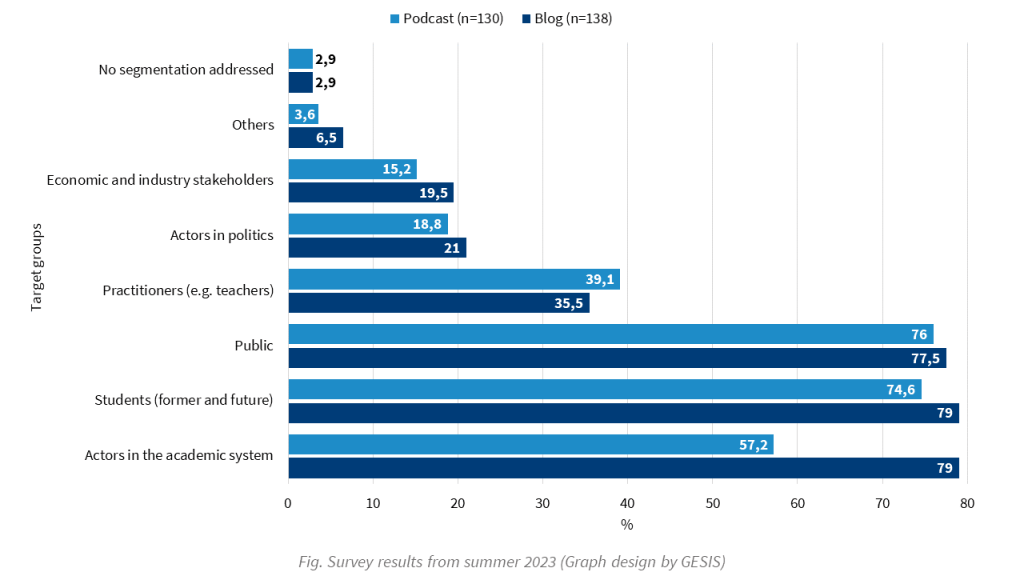
The survey identifies three top target groups: students, members of the scientific community, and the public. The prioritization, however, differs between the knowledge transfer media. While members of the scientific community (79%) and students (79%) are most important for blogs, the public is the top priority for podcasts (76.1%) followed by students (74.6%) and members of the scientific community (57.2%). Nevertheless, at 77.5 percent, the public is no less important for blogs than for podcasts.
By inserting a filter question, we wanted to find out which subgroups the producers who target the public are referring to. Citizens with prior knowledge (63.7%) and those without prior knowledge (56.1%, with podcasts being more influential here) are followed by citizens affected by the research (47.2%) and media representatives (43.4%). In contrast, citizens with no general interest in research and science (17%), as well as children and young people (7%), are represented in only a few blogs and podcasts.
The participants selected an average of three target groups. A surprising finding was that only 7.7% of all media were tailored to a specific target group, meaning they selected just one of the target groups listed in the question. Only three percent of all participants reported not targeting any specific group, with blogs in the natural, life sciences and engineering generating the highest value at 11.8 percent. There are more subject differences among the blogs that are dedicated to a single discipline. At 29.4 percent, economic players are selected significantly more often in the fields of natural sciences, life sciences and engineering than in SSH (4.3%).
Aiming for visibility, social issues, and collaboration
In line with the target groups, the goals focus on both the public and the scientific community. When inquiring about the goals of the blogs and podcasts, we differentiated between general objectives and specific knowledge transfer goals, which were derived from the Transfer Barometer.3
Although four out of twelve transfer objectives were rated as relevant overall, some of the other general objectives were rated slightly higher. The highest-rated objectives were increasing the visibility of research and studies (M=1.5, SD=0.7, 4-point scale), as well as providing insight into the research process (M=1.8, SD=0.9). The third most relevant goal among the general items was addressing important social issues, with podcast producers rating it significantly higher (M=1.6, SD=0.9) than blog producers (M=2.0, SD=0.9). For blog producers, the goal of stimulating research innovation was considered more relevant (M=2.3, SD=0.9) than for podcast producers (M=2.7, SD=1.0).
For both media, the primary knowledge transfer goals are providing knowledge to society (M=1.5, SD=0.7) and engaging in dialogue with the public (M=2.1, SD=1.0). One distinction between the media is the goal of utilizing communication activities to foster collaboration both within academia (M=2.1, SD=0.9) and with external stakeholders (M=2.4, SD=0.9), a goal to which a greater proportion of blogs, as compared to podcasts (M=2.4, SD=1.0; M=2.7, SD=0.9), rated as more relevant.
Survey results drive deeper analysis of high-reach transfer media
Our survey results reveal a rich and active digital knowledge transfer environment in German academia. With a significant number of blogs and podcasts actively engaging their audiences, understanding who we are blogging and podcasting for is a crucial part of effective science communication. Given the differences between blogs and podcasts in their prioritization of target groups and objectives, our next research step will be to analyze 10 best-practice cases from our sample based on survey and performance-analysis results. The final step of the analysis aims to identify key quality features of high-reach blogs and podcasts. Valuable follow-up studies could examine more detailed demographics, especially of the subgroups of the public, and assess whether the goals and target groups intended to be reached are effectively engaged by the transfer media.
More information on the project “How knowledge matters in the context of digitization (Wi4impact) – Impact analysis of science blogs and podcasts of German research universities, universities of applied sciences, and non-university research institutions.” can be found here: https://www.gesis.org/forschung/drittmittelprojekte/wi4impact-projektseite
References
- https://blog.gesis.org/paradigm-shift-in-knowledge-transfer/
- https://blog.gesis.org/wi4impact-2-the-potential-of-digital-media-in-knowledge-transfer/
- Andrea Frank et al., “Transferbarometer: Executive Summary” (Essen, 2022), https://www.stifterverband.org/transferbarometer/executive-summary.
One comment