
Stability, change, and external shocks: Selected results for German public opinion on foreign and security policy
In this post, we analyze long-term trends in security-related attitudes among the German public and recent changes due to the ongoing war between Russia and Ukraine. We will use annual surveys from the Bundeswehr Center for Military History and Social Sciences to cover attitudes towards the Bundeswehr, defense spending, alliance defense, and collaboration with Germany’s NATO partners.
In diesem Beitrag analysieren wir langfristige Trends in den sicherheitspolitischen Einstellungen der deutschen Öffentlichkeit und deren jüngste Veränderungen aufgrund des anhaltenden Krieges zwischen Russland und der Ukraine. Wir nutzen jährliche Umfragen des Zentrums für Militärgeschichte und Sozialwissenschaften der Bundeswehr, um die Einstellungen zur Bundeswehr, zu den Verteidigungsausgaben, zur Bündnisverteidigung und zur Zusammenarbeit mit den deutschen NATO-Partnern zu erfassen.
DOI: 10.34879/gesisblog.2024.83
The ongoing war between Russia and Ukraine remains a dominant topic among the German public. But to what extent has the conflict influenced Germans’ foreign and security policy attitudes? In this blog post, we use survey data from the Bundeswehr Center for Military History and Social Sciences (ZMSBw; https://zms.bundeswehr.de/de) to track long-term trends in German public opinion towards defense and security policy and recent changes due to the outbreak of the full-scale war between Russia and Ukraine in 2022.1 We will focus on attitudes towards the Bundeswehr, defense spending, alliance defense, and collaboration with Germany’s NATO partners.
Attitude towards the Bundeswehr
The people’s attitude towards the Bundeswehr is a central element of civil-military relations in Germany. The respondents of the ZMSBw-surveys can differentiate their general position towards the armed forces with several positive and negative response options. Figure 1 shows the combined percentages for the positive and negative response categories. The patterns are clear and stable since 1999: Between 75 and 86 percent of the German population have a positive attitude towards the armed forces. Only 11 to 23 percent of the German citizens evaluate the Bundeswehr negatively. On the one hand, the long-term stability of high levels of support for the Bundeswehr over a period of about 25 years shows that events and short-term fluctuations, as well as negative news, e.g., about scandals related to sexual harassment or political extremism, cannot shatter the widely shared positive perception of the armed forces in Germany. On the other hand, there is also not much room left for rising support. In contrast to many other indicators discussed in this post, the attitude towards the Bundeswehr only changed gradually after the full-scale Russian attack on Ukraine in 2022.
Figure 1: Attitude towards the Bundeswehr in Germany 1999-2023
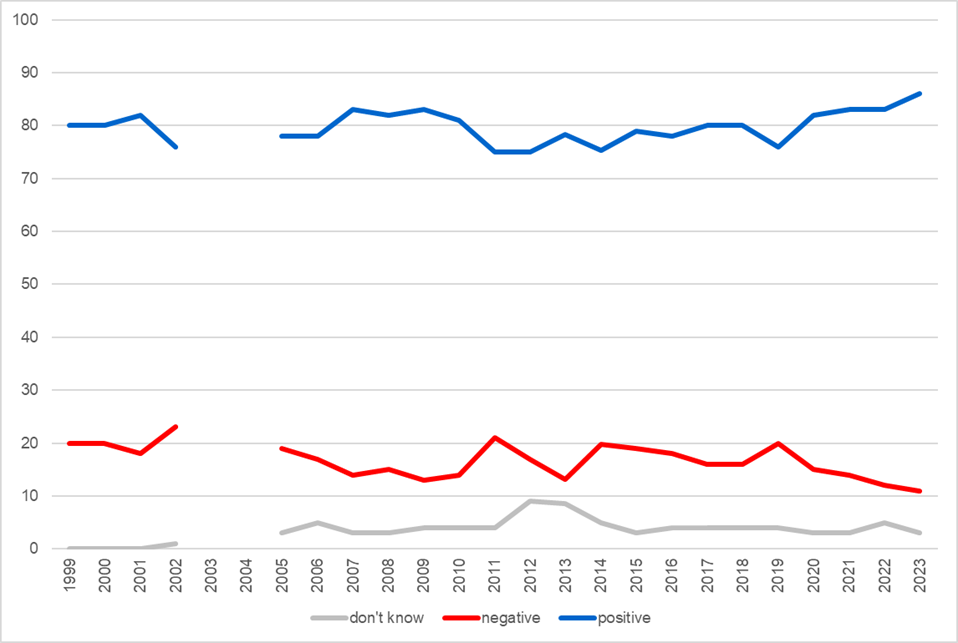
Data: Public opinion surveys by SOWI and ZMSBw 2000-2023, “Wehrpolitische Lage” (Defense policy survey) 1999.
Attitude on defense spending
As the long-lasting debate on NATO’s two percent goal for defense expenditures and the decision about the special defense fund (“Sondervermögen”) in Germany show, the question of how many economic resources should be provided for the armed forces is another core topic of civil-military relations and policy-making in general. The ZMSBw-surveys and its predecessors have asked Germans about their position towards changes in defense spending since 1981 (see Figure 2). Survey respondents could say whether they want to increase or decrease the defense budget or keep it at the same level.
The development of public opinion on the defense spending issue mirrors the development of Germany’s security situation. With the detente of the Cold War during the 1980s, the share of (West) Germans who wanted to decrease defense spending went up from 27 percent in 1981 to 54 percent in 1989. After the end of the Cold War, a clear majority of people, beyond 60 percent, favored defense spending cuts and collecting the so-called peace dividend. Accordingly, the share of those citizens who want to keep defense spending at the same level or who want to increase it goes down. The lowest level for these options over the whole time period either occurs in 1991 (three percent in favor of increased defense spending) or in 1992 (28 percent want to keep spending at the same level). However, the majority for defense spending cuts already vanishes after the mid-1990s. Keeping the defense budget at the same level became the new majority position from 1995 until 2013. Between 44 and 59 percent favor this position, either constituting a relative or absolute majority.
2001 shows a dramatic change in public opinion: The share of Germans who want to spend more on defense went up after the 9/11 attacks in the United States: 42 percent favor an increase in defense spending, which is the highest level of support between 1981 and 2014. However, the effect of the 9/11 attacks does not last long, which is indicated by a sharp drop in the graph in the years after 2001. Support for more expenses on defense is hovering between 20 and 30 percent from the end of the 1990s until 2014. The year 2014 was a turning point (“Zeitenwende“) for the German public‘s position on defense spending after the start of the war in Ukraine, the rise of ISIS in Syria and Iraq, and the strong focus of the German elite discourse on the growing international responsibility of Germany. The share of Germans who want to spend more on defense goes up from 19 to 32 percent in 2014, while there is still a relative majority of 46 percent who want to keep defense expenditures at the same level. Starting with 2015, a relative or absolute majority of Germans constantly want to increase defense spending. In 2022, this position’s support level climbed to an all-time high, with 59 percent who favor more defense expenses. The changes are mainly driven by widespread perceptions of Russia as a threat and the negative evaluation of the Bundeswehr’s equipment and armament.
The overall development of public opinion on the defense spending issue shows a strong volatility that can be plausibly linked to relevant events and changes in Germany’s objective security situation. The empirical findings confirm the concept of the “rational public” and indicate that there has been a “Zeitenwende” in public opinion, at least on this topic, before the “Zeitenwende” in political discourse and decision-making in 2022.
Figure 2: Attitude on defense spending in Germany 1981-2023
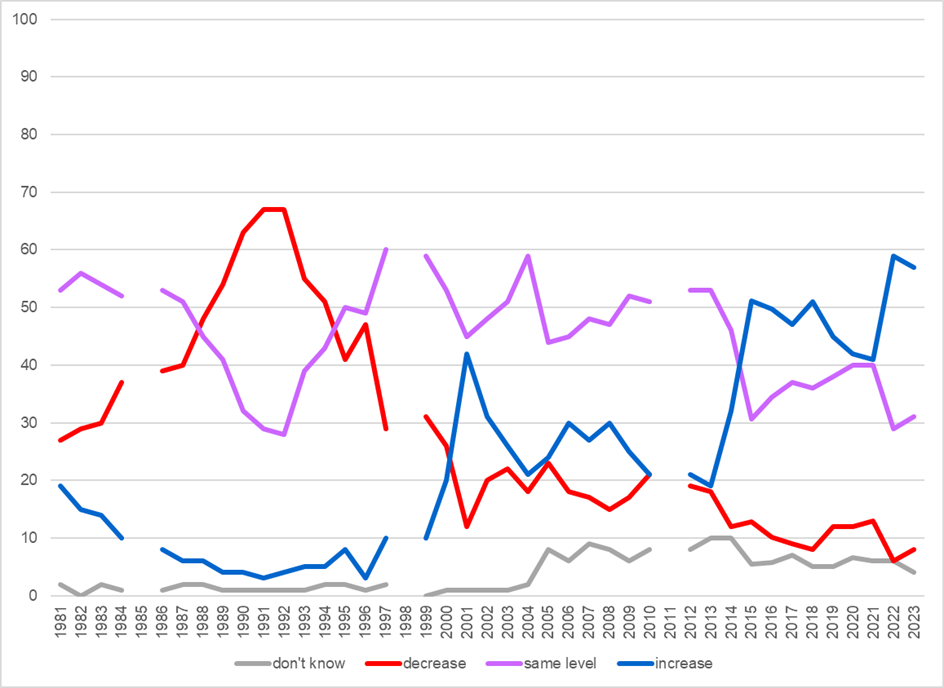
Data: Public opinion surveys by SOWI and ZMSBw 2000–2002, 2005–2010, 2012–2023, “Wehrpolitische Lage” (Defense policy survey) 1981–1984, 1986–1997, 1999, 2003–2004.
Attitudes on alliance defense
A strong preference for multilateralism, i.e., close cooperation with Germany’s allies in NATO and EU, is part of German strategic culture. This is reflected by the empirical results in Figure 3, which include two indicators of multilateralism or alliance defense in general and two specific measures or actions of alliance solidarity. Support for Germany’s NATO membership and assistance to an ally who is under attack hovers in a narrow range between 69 and 75 percent between 2016 and 2023, clearly emphasizing Germany’s commitment to alliance membership and duties. However, Figure 3 reveals a gap between high levels of support for alliance defense as a general principle of German foreign and security policy and moderate or rather low levels of commitment to specific measures or actions between 2016 and 2021. Only 24 to 36 percent of the German population favor supporting the Baltic States in defending themselves against Russia or deploying more NATO troops to Eastern Europe during this period. German support for these actions went up to about 50 percent after the outbreak of the full-scale war in Ukraine in 2022, indicating a declining discrepancy in public opinion due to an external shock. However, the drop in support levels for specific measures of alliance solidarity by six and seven percentage points, respectively, in 2023 shows that the impact of the shock seems to be disappearing already. Accordingly, the gap between general commitment to Germany’s NATO membership and specific measures of alliance solidarity is growing again.
Figure 3: Attitudes on alliance defense
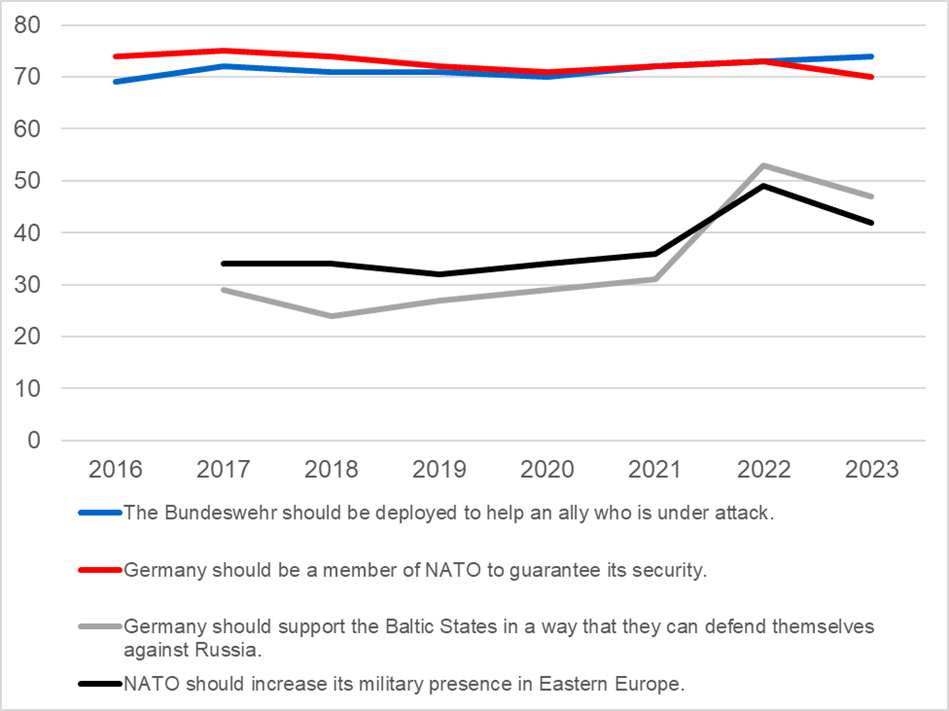
Data: Public opinion surveys by ZMSBw 2016–2023.
Conclusion
This post aimed to showcase selected results from the ZMSBw-surveys and to look at some long-term trends in German public opinion on defense and security policy and some changes in the context of the war between Russia and Ukraine. The examples show stability (attitude towards the Bundeswehr, multilateralism in general) as well as volatility (attitude on defense spending) and comprehensible reactions of German public opinion to external shocks or relevant events (attitudes on specific measures of alliance solidarity). Overall, the data provide a large and unique set of opportunities for scholars interested in German public opinion on foreign, defense, and security policy. The datasets also include socio-demographic characteristics, party preferences, and a large set of political attitudes that allow for all kinds of bivariate and multivariate analyses. The ZMSBw-surveys can be found here (https://tinyurl.com/3ynxad9h).
Further reading
Graf, T. (2021a). Trendradar 2021. Die öffentliche Meinung zur Sicherheits- und Verteidigungspolitik in der Bundesrepublik Deutschland im Zeitverlauf. Forschungsbericht Nr. 129. Potsdam: Zentrum für Militärgeschichte und Sozialwissenschaften der Bundeswehr. https://opus4.kobv.de/opus4-zmsbw/frontdoor/index/index/searchtype/series/id/3/docId/510/start/7/rows/10
Graf, T. (2021b). Freundliches Desinteresse als Bilanz? Die Einstellung der Deutschen zum Bundeswehreinsatz in Afghanistan auf dem Prüfstand. In: Zeitschrift für Außen- und Sicherheitspolitik 14 (4), 411–436. https://link.springer.com/article/10.1007/s12399-021-00873-6
Graf, T. (2024). Was bleibt von der Zeitenwende in den Köpfen? Sicherheits- und verteidigungspolitisches Meinungsbild in der Bundesrepublik Deutschland 2023. Forschungsbericht Nr. 136. Potsdam: Zentrum für Militärgeschichte und Sozialwissenschaften der Bundeswehr. https://opus4.kobv.de/opus4-zmsbw/frontdoor/index/index/searchtype/series/id/3/docId/724/start/0/rows/10
Graf, T., Steinbrecher, M., & Biehl, H. (2024). From reluctance to reassurance: Explaining the shift in the Germans’ NATO alliance solidarity following Russia’s invasion of Ukraine. In: Contemporary Security Policy 45 (2), 298–330. https://doi.org/10.1080/13523260.2023.2286771
Steinbrecher, M. (2021). Im Urteil der Bürgerinnen und Bürger: militärbezogene Bevölkerungsbefragungen. In: Elbe, M, Biehl, H., & Steinbrecher, M. (eds.), Empirische Sozialforschung in den Streitkräften. Positionen, Erfahrungen, Kontroversen. Berlin: Berliner Wissenschafts-Verlag 323–349. https://www.steiner-verlag.de/Empirische-Sozialforschung-in-den-Streitkraeften/9783830551362
Steinbrecher, M., & Koppenhöle, H. (2024). Vom Münchner Konsens zur Zeitenwende? Stabilität und Wandel der sicherheitspolitischen öffentlichen Meinung in Deutschland zwischen 2013 und 2021. In: Elbe, M., & Dörfler-Dierken, A. (eds.), Bundeswehr und Gesellschaft – Wahrnehmungen im Wandel. Wiesbaden: Springer VS, 205–234. https://link.springer.com/chapter/10.1007/978-3-658-43359-8_11
Steinbrecher, M. & Wanner, M. (2021). Alles eine Frage des Erfolgs? Einstellungen zum internationalen Engagement Deutschlands und zum Einsatz in Afghanistan. In: Maurer, J., & Rink, M. (eds.), Einsatz ohne Krieg? Militär, Gesellschaft und Semantiken zur Geschichte der Bundeswehr nach 1990. Göttingen: Vandenhoeck & Ruprecht, 257–278. https://zms.bundeswehr.de/de/zmsbw-publikationen-einsatz-ohne-krieg-5324018
References
- The Bundeswehr Center for Military History and Social Sciences (ZMSBw; https://zms.bundeswehr.de/de) and its predecessor Bundeswehr Institute of Social Sciences (SOWI) have conducted public opinion surveys on behalf of the German Ministry of Defense since 1996. On an annual basis, representative samples of Germans have been asked about their perception of the Bundeswehr and its foreign missions, civil-military relations in general, threat perceptions, and attitudes toward foreign and security policy issues, to name just a few topics. The data are unique as they are the only survey series on German foreign, defense, and security policy attitudes that cover a broad set of topics over a period of about three decades. Accordingly, the data provide many opportunities for scholars interested in German public opinion on foreign, defense, and security policy. All datasets except the most recent ones are available from the GESIS Data Archive (https://tinyurl.com/3ynxad9h).
Leave a Reply